


Recently, Steven Lausell Recurt, Esq., was sent by the Puerto Rican Institute of International Relations to participate in the Pacific Regional Seminar on the Implementation of the Fourth International Decade for the Eradication of Colonialism, organized by the United Nations C24. The seminar took place in Dili, Timor-Leste, from May 21 to 23 of this year. Puerto Rico’s participation reaffirms to the international community that, in accordance with international law, Puerto Ricans are fulfilling their responsibility to bring Puerto Rico’s case to the necessary international forums.
Lausell Recurt affirms that “Puerto Rico’s case is alive in the international arena” and reported via telephone interview that Puerto Rico’s representation was extremely important, as the archipelago was able to occupy a central place in the discussions surrounding the Caribbean region, where the cases of the British Virgin Islands and Montserrat were also mentioned. At least five C-24 member countries expressed their support for Puerto Rico’s independence, including Bolivia, Cuba, Nicaragua, Russia, and Venezuela.
The C-24 supports the application of resolution 1514 (XV) to the colonial situation of Puerto Rico and the right of the Puerto Rican people to self-determination and independence. “In Puerto Rico, we continue to fight for our right to remain a member of the international community,” said Attorney Lausell Recurt.
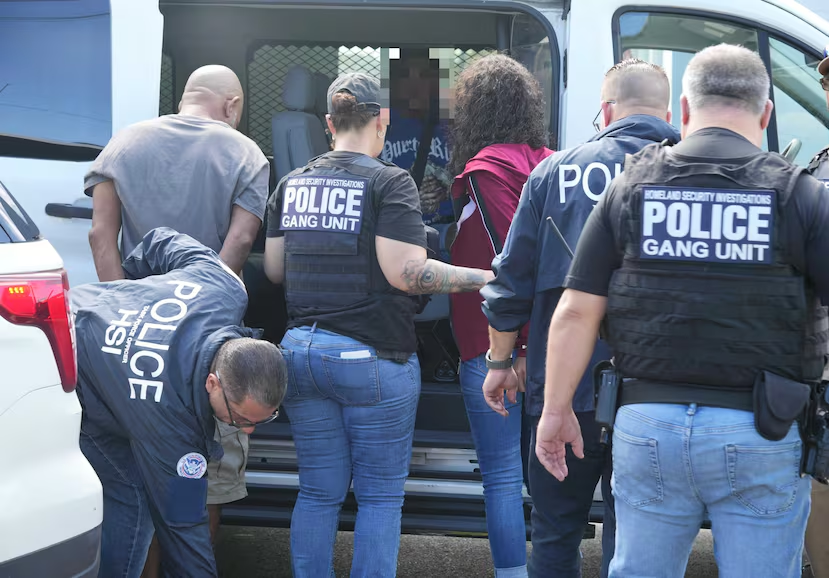
San Juan, Puerto Rico – Latin American and Caribbean, but its colonial subjection to the United States forces the colonial government to implement policies and practices of persecution and incarceration against our Latin American and Caribbean brothers and sisters under the US government’s ICE (Immigration and Customs Enforcement) program.
In Puerto Rico, NO ONE IS ILLEGAL, and NO ONE should be persecuted for their immigration status. Furthermore, this is especially true when considering that US citizenship and compulsory military service were imposed by the US government in 1917 through the Jones-Shafroth Act, just as the US decided to intervene in World War I to support the European Allied powers in the face of the threat of the Zimmerman Telegram* and the sinking of US merchant ships by Germany.
The Committee for Human Rights of Puerto Rico recently expressed its condemnation on its Facebook page of “the actions of the administration of Jennifer González Colón for violating the constitutional rights to human dignity, privacy, and equal protection of the laws by handing over confidential information of its citizens to the federal government.” The CPDHPR statement continues, “Our colonial relationship, instead of being an excuse to hand over the immigrant population to federal agencies for deportation, should be the main reason to defend them, since these detentions go against the principles and values of brotherhood and human dignity that our people represent.”
Abuja hosts international conference to eradicate colonialism from the world

Image source: IPRI
Abuja, Nigeria – The Puerto Rican Institute of International Relations (IPRI) actively participated in the International Conference to Eradicate Colonialism from the World on August 12 and 13, 2024, under the theme “Forgotten Peoples.” This event was convened by the Society for International Relations Awareness (SIRA), based in the host country of Nigeria.
Among SIRA’s achievements in holding this event were the outstanding composition of the organizers and participants. Among the speakers were the ambassadors of Cuba and Mexico. The Caribbean was well represented by the Puerto Rican delegation and the presentations given by Carlos Alicea, Estelí Capote, former political prisoner Edwin Cortés, and comrades Jihad Abdulmumit and Kazi Touré, the latter two representatives of the Jericho Movement in support of Puerto Rican independence. Kandis Sebro, invited by IPRI, also spoke, representing the Caribbean colonies and countries as a member of the Assembly of the Peoples of the Caribbean and Operational Secretariat of ALBA Movements in Latin America and the Caribbean. Puerto Rican Bertha Joubert also participated, representing Women in Struggle.
It is worth noting that the event was moderated by Professor Ibrahim Gambari, CFR, former President of UNICEF, former Minister of International Affairs of Nigeria, and President of the UN Special Committee against Apartheid, among other roles. Also participating were Sahrawi Ambassador Oubi Bachir of Polisario and international human rights lawyer Femi Falana, who served as a catalyst for the conference’s programmatic achievements.
As a conclusion to the International Conference on the Eradication of Colonialism from the World, under the theme “Forgotten Peoples”—convened and organized by the Society for the Awareness of International Relations and the jurist Falana—the Working Group on the Eradication of Colonialism from the World (ECM) was established. Following the principles of UN General Assembly Resolution 1514 XV of December 14, 1960, the Abuja Framework to Decolonize the World was adopted. Read the full article at: https://claridadpuertorico.com/puerto-rico-se-convierte-en-caso-de-estudio-para-erradicacion-del-colonialismo/
Being a colony is expensive for Puertoricans
by José Escoda

Among the myths propagated by the Yankee empire regarding its control over Puerto Rico is that our economy depends on handouts from the United States. This lie has spread so widely that it resembles an unquestionable truth. Economic data on Puerto Rico refutes this contention. For example, we recommend watching online: youtube.com/watch?v=4Kdvw7Ab4uM ; where Puerto Rican economist Rosario Rivera addresses the core of this lie.
Imperialism exploits us ruthlessly every day. Among its greatest plunders are those committed by its healthcare companies. First, in direct taxes, they take about 15% of ALL salaries for their social security plans. And it must be remembered that the US is the only “developed” country that doesn’t have a universal healthcare system. Its average spending on healthcare is $9.4 billion annually, and that’s private spending. That spending is 250% higher than the world average. And they charge us for that difference in Puerto Rico.* The cost of medical care in Puerto Rico is eight times more expensive than in Mexico and twice that of Japan. Oh, someone might say that salaries in Puerto Rico are higher. Well, look: the average salary in Puerto Rico seems high, but salaries in Puerto Rico are 50% lower than those in the US, on average 4.5% higher than in Mexico (compared to medical costs eight times higher), and the average is 80% higher than in Japan (with medical costs twice as expensive). Meanwhile, medicines, machinery, medical procedures, even ambulances and canes are forced to follow Yankee prices.
Ah, someone will say that salaries in Puerto Rico are higher. Well, look: the average salary in Puerto Rico seems high, but salaries in Puerto Rico are 50% lower than those in the US, on average 4.5% higher than in Mexico (compared to medical costs 8 times more expensive), and the average is 80% of that of Japan (with medical costs twice as expensive). Meanwhile, medicines, machinery, medical procedures, even ambulances and canes are forced to follow Yankee costs.
In other words, the empire charges us the same as its population, pays us half, and then says they “support us.” That’s only in healthcare; this is demonstrated in every line; more on that later.
—
*The only difference in costs is in the salaries paid in Puerto Rico, which even in healthcare are about half those in the US.
Leave a Reply